Today's Total: 20 hours 9 minutes
I can remember a time about five years ago where getting 3 hours a day in playing and practice time was easy. A buddy of mine has at one point logged closer to 8 hours a day average. However, being that I'm a stay at home dad with a kid that just learned to crawl... I'm averaging 45 minutes a day so far.
The trick I'm finding is trying to look in between activities to get more time in. Even if that is just running a scale up and down and then playing through the changes of a random tune. Really, content isn't my problem. It's freedom.
I figure to reach the goal in two years (May 6, 2018), I would need to average about an hour and a half each day. That actually puts me ahead a little. I think I actually got 1.36 hours as my number. Either way, I'm half way to my average goal which means I have a lot of catching up to do.
The good news is that I've recently hit a streak of booking gigs. Adding a 2 hour gig into my mix hear and there makes a huge difference! Plus, I work a couple days a week at my church and I hadn't gotten to focus on music while there the last couple of weeks. Starting this week, that will change a lot.
There is a lot to be hopeful for. I'll be making it eventually!
Showing posts with label music. Show all posts
Showing posts with label music. Show all posts
Monday, May 23, 2016

Monday, May 9, 2016
The Thousand Hour Project
For a couple of years now I had heard this rather new adage that mastery of anything comes at about ten thousand hours. The idea is basically that if you spend ten thousand hours of concentrated study on a subject, then by default you have mastered it. It's a great idea and definitely a way to give some sort of quantifiable idiom to mastery.
But, I don't necessarily believe it.
Still, the challenge of getting ten thousand hours gets at me. If you break that down, that is 416.66 days. Over a year straight of playing before you are a master at your musical instrument. When you put in all the other things in life like family, food, sleep, church, video games, movies, driving, etc, etc... That sort of commitment and achievement is sort of awesome!
Doing a small amount of research as I am writing this post, I came across someone who is working on 10,000 hours towards golf mastery. Apparently, this guy quit his job and devoted himself to it. I can't tell if I'm inspired or skeptical. Either way, I'm not alone on my quest.
For me, I can't see myself getting more than about a an hour to two hours each day of practice and play time. I would wrap any time on the fretboard as counting for this because I try earnestly to be learning even in a performance situation. I don't believe you can ever not be learning. So, at 2 hours a day, it should take me 5,000 days to achieve. That's 13 years. Damn.
But what about just a thousand hours? I mean, I've already been playing music since 1992. I've got a lot of back time to look at. Now, we are just talking 500 days. Even though I see 13 years as obtainable, just under two is much more palatable.
So, there is my first goal... Log 1,000 hours of play time. Once I've accomplished that, we'll see what is next.
But, I don't necessarily believe it.
Still, the challenge of getting ten thousand hours gets at me. If you break that down, that is 416.66 days. Over a year straight of playing before you are a master at your musical instrument. When you put in all the other things in life like family, food, sleep, church, video games, movies, driving, etc, etc... That sort of commitment and achievement is sort of awesome!
Doing a small amount of research as I am writing this post, I came across someone who is working on 10,000 hours towards golf mastery. Apparently, this guy quit his job and devoted himself to it. I can't tell if I'm inspired or skeptical. Either way, I'm not alone on my quest.
For me, I can't see myself getting more than about a an hour to two hours each day of practice and play time. I would wrap any time on the fretboard as counting for this because I try earnestly to be learning even in a performance situation. I don't believe you can ever not be learning. So, at 2 hours a day, it should take me 5,000 days to achieve. That's 13 years. Damn.
But what about just a thousand hours? I mean, I've already been playing music since 1992. I've got a lot of back time to look at. Now, we are just talking 500 days. Even though I see 13 years as obtainable, just under two is much more palatable.
So, there is my first goal... Log 1,000 hours of play time. Once I've accomplished that, we'll see what is next.
Saturday, November 1, 2014
Should You Learn to Read and Write Music?
Go out to a guitar or ukulele forum right now and post this question. Wait about an hour and look at the responses... I'm betting that you have just started a forum war. Half with say you should, while the other will say you shouldn't. Both opinions will likely not answer the question for you. And, at the end of the day, you will still struggle with the question in your own head.
So, here's my take:
I've never met a musician who learned to read and write music who said it was a waste of time. This is true of all instrumentalists: guitar, ukulele, piano, trumpet, accordion, etc. It has always been a rewarding pursuit.
That said, to be proficient at it, you will have a lot of work ahead of you.
Why it's a good idea:
Basically, it boils down to communication. If you cannot effectively communicate your musical ideas to other musicians (or to your future self), then you are setting your music up to fail. reading and writing music is how we communicate "off instrument". Words don't work for us.
Think about it like music is a foreign language, like Italian. You can listen to tapes and learn to speak the Italian, but as soon as you are reading the menu at a cafe in Venice you are going to be at a loss because you never learned how to read those words properly. Sure, you might stumble through it, but there will be a loss in translation.
Music is no different. You can listen and learn how to play a tune, but as soon as you are trying to get your point across to other musicians off instrument, you're lost.
Amateur vs. Professional
Obviously, in the guitar and ukulele world (and many other fretted instruments) there is clearly no emphasis on reading music efficiently. We are only really expected to read chord symbols and lyrics off of a chord sheet and that's about it. And that is totally fine. There is NOTHING wrong with being an amateur musician. Keep it simple and keep it fun. That's the point!
But, if you are a budding professional musician, then you need to dedicate yourself to understanding the craft. Sure, you can play "All the Things You Are" with a beautifully crafted chord melody and bass line. However, can you communicate what you are doing so the rest of your band can understand where to come in?
Maybe you intend on being a soloist your entire musical career... That's fine too. Nothing wrong with that. But, as many musicians will agree, your future self is very forgetful. Having a way to document how you did something makes remembering it later as easy as reading.
In the long term, learning to read and write music is a great skill. If you only get into it a little as an amateur musician, that's fine. But, as you work your way towards being a musician of professional quality, it is essential that you can communicate with other musicians.
~Danny
P.S.: There is another reason you should learn to read music: money. There are literally thousands of musicians out there that are trying to get noticed. Being able to read off of a piece of sheet music will get you noticed. Getting noticed gets you hired! I've had a few jobs that came to me because I could read and the other guy couldn't (these were musicals). It is worth it!
So, here's my take:
I've never met a musician who learned to read and write music who said it was a waste of time. This is true of all instrumentalists: guitar, ukulele, piano, trumpet, accordion, etc. It has always been a rewarding pursuit.
That said, to be proficient at it, you will have a lot of work ahead of you.
Why it's a good idea:
Basically, it boils down to communication. If you cannot effectively communicate your musical ideas to other musicians (or to your future self), then you are setting your music up to fail. reading and writing music is how we communicate "off instrument". Words don't work for us.
Think about it like music is a foreign language, like Italian. You can listen to tapes and learn to speak the Italian, but as soon as you are reading the menu at a cafe in Venice you are going to be at a loss because you never learned how to read those words properly. Sure, you might stumble through it, but there will be a loss in translation.
Music is no different. You can listen and learn how to play a tune, but as soon as you are trying to get your point across to other musicians off instrument, you're lost.
Amateur vs. Professional
Obviously, in the guitar and ukulele world (and many other fretted instruments) there is clearly no emphasis on reading music efficiently. We are only really expected to read chord symbols and lyrics off of a chord sheet and that's about it. And that is totally fine. There is NOTHING wrong with being an amateur musician. Keep it simple and keep it fun. That's the point!
But, if you are a budding professional musician, then you need to dedicate yourself to understanding the craft. Sure, you can play "All the Things You Are" with a beautifully crafted chord melody and bass line. However, can you communicate what you are doing so the rest of your band can understand where to come in?
Maybe you intend on being a soloist your entire musical career... That's fine too. Nothing wrong with that. But, as many musicians will agree, your future self is very forgetful. Having a way to document how you did something makes remembering it later as easy as reading.
In the long term, learning to read and write music is a great skill. If you only get into it a little as an amateur musician, that's fine. But, as you work your way towards being a musician of professional quality, it is essential that you can communicate with other musicians.
~Danny
P.S.: There is another reason you should learn to read music: money. There are literally thousands of musicians out there that are trying to get noticed. Being able to read off of a piece of sheet music will get you noticed. Getting noticed gets you hired! I've had a few jobs that came to me because I could read and the other guy couldn't (these were musicals). It is worth it!
Friday, August 8, 2014
Albums Are Hard Work
In the last few weeks I've embarked on the long project of producing my first album. From the get go this has been a hard work affair. Kind of funny that all I wanted was a debut album and I'm spending tons of time trying to work out tiny details.
Luckily, I know a bunch of folks who have been there before and have given me a little nudge in the right direction. That coupled with a few online resources (such as DiskMaker.com) and I'm a little amazed that the complicated process is actually started to see some traction as it moves out of the planning phases.
Let me briefly outline the process as I've been working through it:
Planning
- This is the figuring out of almost every thematic detail of the album.
- The biggest parts of planning aren't actually in the artistic realm at all.
- You have to come up with a generally specific (oxymoron?) budget to get funding.
- You have to figure out how you are getting that funding (Kickstarter.com).
- You have to figure up a timeline for music prep, recording, art, photos, and pressing.
- You have to figure out debut and release stuff.
Music Prep
- I'm not here officially yet, but I'm already working it.
- Picking tunes you are covering.
- Picking and writing original tunes.
- Arranging all of those tunes and picking your favorites.
- Hiring musicians to fill in the background.
Recording
- Home or in studio?
- How long do you need?
- Who is mixing?
- Who is mastering?
Pressing
- Art
- How many CDs?
- Downloads? If so, how many?
- Licensing. Even originals need to be copyrighted!
- Getting all the ducks in a row and to the pressing company.
Release
- Who is getting a copy off the bat?
- Party?
- Local release?
- Online release?
Within all of that are little details too like putting youtube vids together to support crowdsourcing (I'm still working on that... It's been a long ass week!), brainstorming, throwing ideas at other people and having them handed back to you with a look of "really?" on their face, etc.
In the end, I'm hoping the first album is at least a small success. If nothing else, the goal is to get a discography started for myself so that when people ask what I do, I can literally show them.
More to come as crowdsourcing and youtube videos go up. Keep posted!
~Danny
Luckily, I know a bunch of folks who have been there before and have given me a little nudge in the right direction. That coupled with a few online resources (such as DiskMaker.com) and I'm a little amazed that the complicated process is actually started to see some traction as it moves out of the planning phases.
Let me briefly outline the process as I've been working through it:
Planning
- This is the figuring out of almost every thematic detail of the album.
- The biggest parts of planning aren't actually in the artistic realm at all.
- You have to come up with a generally specific (oxymoron?) budget to get funding.
- You have to figure out how you are getting that funding (Kickstarter.com).
- You have to figure up a timeline for music prep, recording, art, photos, and pressing.
- You have to figure out debut and release stuff.
Music Prep
- I'm not here officially yet, but I'm already working it.
- Picking tunes you are covering.
- Picking and writing original tunes.
- Arranging all of those tunes and picking your favorites.
- Hiring musicians to fill in the background.
Recording
- Home or in studio?
- How long do you need?
- Who is mixing?
- Who is mastering?
Pressing
- Art
- How many CDs?
- Downloads? If so, how many?
- Licensing. Even originals need to be copyrighted!
- Getting all the ducks in a row and to the pressing company.
Release
- Who is getting a copy off the bat?
- Party?
- Local release?
- Online release?
Within all of that are little details too like putting youtube vids together to support crowdsourcing (I'm still working on that... It's been a long ass week!), brainstorming, throwing ideas at other people and having them handed back to you with a look of "really?" on their face, etc.
In the end, I'm hoping the first album is at least a small success. If nothing else, the goal is to get a discography started for myself so that when people ask what I do, I can literally show them.
More to come as crowdsourcing and youtube videos go up. Keep posted!
~Danny
Sunday, July 27, 2014
Laying Some Ground Work
I found out recently that I'm being invited back to the Folk Alliance's Winter Music Camp this year. It was one of the most awesome music experiences I have ever had last year and I am extremely excited to get to work with Mark Ruben and his team again.
During last year's event, I was encourage by Mark, Pops Bayless, Guy Forsyth, and countless others to take advantage of the conference that happens along side the camp. The conference is basically a place where the artists and the industry can get together and make those crucial relationships that enable music to be what it is.
There is a trade show floor where everything from promotion companies and CD companies (like CD Maker) to string makers (like D'Addario) and instrument makers (like Nechville Banjos) can work directly with artists and novices. There are jam sessions happening in every hallway or public (or private) space in the hotel. There is a keynote speaker and tons of music industry info passed out.
But what makes the event special for the artists is the showcases.
Showcases are an opportunity for artists to play their music for a wide array of people including promoters, club owners, other musicians, and just plan fans. The goal of which is to get yourself know as a performer and get more gigs.
Last year, the showcase was the single most suggested thing that everyone seemed to tell me I had to do. As much as I trust that advice, I am extremely glad I didn't. Why? Because I would have been in way over my head. I had no album, no promotional material, barely even a website. Hell, I wasn't really even settling into a genre yet!
But this year... This year I'm going whole hog.
I've got a lot of goals I need to accomplish between now and then, but basically they boil down to one overarching goal to help get the most out of a showcase: I need to release an album.
I won't go into everything that I need to do to make this happen just yet. Lord knows I will be putting my experience out here for everyone to live along with. But already without even laying down a single track I am getting the feeling that this may be one of the biggest projects I have ever undertaken.
Here is my short list of to-dos and dailies:
- Write music everyday
- Record something everyday
- Pick 10 songs (5 originals, 5 standards) to put on the album
- Get album art created
- Photo shoot (for website, showcase flyers, and album)
- License songs (copyright mine, get rights to standards)
- Record album (pro studio or home studio?)
- Produce the actual CDs (mix, master, buy)
- Merch, Merch, Merch
As you can see, there is a lot and within each of those is a whole ball of questions to be answered. How do we eat an elephant? One bite at a time.
~Danny
Tuesday, January 31, 2012
Music Lesson 3B: Time Values
This is a continuation of a lesson on staff music from a previous post.
Time Values
You likely already know that music has a beat. Most of us have tapped our feat or clapped along to a song. You have probably also already noticed that some beats are longer than others. Well, we have a hand little system to work out how those beats should go.
We'll start with a whole note. The whole note is just a circle on the staff that represents 4 beats.

Now, if we half that, it becomes a half note (see what we did there?). Half notes are the little circles but with a bar going straight up or straight down. They get 2 beats.
 Now we get to the quarter note. A quarter is half of half and gets 1 beat. The symbol is the half note with the circle filled in (like a dot with a stick coming out of it).
 Next, is the eighth note. All we do is add a flag to the quarter and it becomes an eighth. If we have two or more of them next to each other, then we tie their flags together. They get half of 1 beat.
 Next, is the sixteenth note. Add another flag, and they get one quarter of a beat. We can keep adding flags and keep going, but this is the gist.
Here is a basic break down of rhythm notes:
 We can modify any of these in a couple of important ways. First is the "Dot". A Dot looks like, well, a dot added to the right of the note. It adds one half of the value of the note to its length. So, a dotted half, like our example here, would be 2 beats, plus 1 beat, equals 3 total beats.

Secondly, we can use a Tie. Ties combine notes together to make them longer or to show a more connected movement from one pitch to another (also know as a Slur). Sometimes, Ties are used to connected the same note from one side of a Bar to the other (see below). To get the time value, just add the values of each of the notes up.
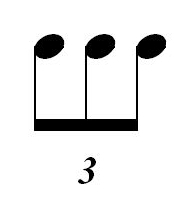
 Lastly, we have syncopation, also known as triplets. Most triplets will be in values of three such as 3, 6, 9, etc. Usually, you will only see triplets in 3s. But, any odd number can be used in syncopation. The basic format looks like this:
 Lastly, there are specific symbols in rests that we use for each division of beat. Rather than go through them all again, here is the tree for their values:
 Come back for the next section of music notation which deals with key signatures, time signatures, and repeats.
Time Values
You likely already know that music has a beat. Most of us have tapped our feat or clapped along to a song. You have probably also already noticed that some beats are longer than others. Well, we have a hand little system to work out how those beats should go.
We'll start with a whole note. The whole note is just a circle on the staff that represents 4 beats.

Now, if we half that, it becomes a half note (see what we did there?). Half notes are the little circles but with a bar going straight up or straight down. They get 2 beats.


Here is a basic break down of rhythm notes:


Secondly, we can use a Tie. Ties combine notes together to make them longer or to show a more connected movement from one pitch to another (also know as a Slur). Sometimes, Ties are used to connected the same note from one side of a Bar to the other (see below). To get the time value, just add the values of each of the notes up.


Monday, November 7, 2011
Music Lesson 3A: Basics of Standard Notaion
Now that we have delved into a bit of the layout of the chromatic and the major scale, it is time for us to look at how musicians look at music: Standard Notation.
There is a lot of argument amongst musicians on whether reading Standard Notation is a necessary skill for guitarists (or ukulele players). There are a lot of valid points on both sides of the line, but there is one major reason why I encourage it: Because it is the standard way that music is presented. Countless volumes of sheet music are accessible to you as a guitar or ukulele player if you can only learn enough to see it.
The Staff
The Staff is where it all happens. On the page of music, it is basically the lines where the music is written. By itself, we should think of it as simply a time line where everything will be written out from left to right in chronological order.

The Staff consists of five horizontal lines running parallel to each other. Notes are represented as either on a line or in a space. The lower the tone of the note, the lower its position on the staff; the higher the note, the higher it's position. If a note is higher (or lower) than the highest of the five lines of the staff, we add a small line above (or below for low notes) to make room for the note.
The Clefs
There are two basic clefs in music*: The Treble Clef and the Bass Clef. For guitars and ukuleles, we usually will be using the Treble Clef, but knowing the Bass clef can be useful.
Clefs are used to indicate where the notes are to be located on the staff. Notice how one end of the Treble Clef seems to wrap around the second line from the bottom of the Staff. This is the clef's way of telling us where the note "G" is. Treble Clef is sometimes referred to as "G Clef". The Bass Cleff tells us where the "F" note is in a similar way. Look at the line (second from the top of the staff) with the two dots above and below it. That is the position of the "F" note.
Here's where the notes go on the staff with the Bass and the Treble Clefs:

Sub-Conclusion
After writing out this post, I decided to break up Standard Notation into a few lessons. There is just a lot to cover. Still to come are descriptions of Key Signatures, Time Signatures, Repeats, and Time Values of notes. See the next post for more on this subject.
~DB
* There are numerous others, but the treble and the bass clef are generally considered to be the most used and well know.
There is a lot of argument amongst musicians on whether reading Standard Notation is a necessary skill for guitarists (or ukulele players). There are a lot of valid points on both sides of the line, but there is one major reason why I encourage it: Because it is the standard way that music is presented. Countless volumes of sheet music are accessible to you as a guitar or ukulele player if you can only learn enough to see it.
The Staff
The Staff is where it all happens. On the page of music, it is basically the lines where the music is written. By itself, we should think of it as simply a time line where everything will be written out from left to right in chronological order.

The Staff consists of five horizontal lines running parallel to each other. Notes are represented as either on a line or in a space. The lower the tone of the note, the lower its position on the staff; the higher the note, the higher it's position. If a note is higher (or lower) than the highest of the five lines of the staff, we add a small line above (or below for low notes) to make room for the note.
The Clefs
There are two basic clefs in music*: The Treble Clef and the Bass Clef. For guitars and ukuleles, we usually will be using the Treble Clef, but knowing the Bass clef can be useful.
 |
| right: Treble Clef, left: Bass Clef |
Clefs are used to indicate where the notes are to be located on the staff. Notice how one end of the Treble Clef seems to wrap around the second line from the bottom of the Staff. This is the clef's way of telling us where the note "G" is. Treble Clef is sometimes referred to as "G Clef". The Bass Cleff tells us where the "F" note is in a similar way. Look at the line (second from the top of the staff) with the two dots above and below it. That is the position of the "F" note.
Here's where the notes go on the staff with the Bass and the Treble Clefs:

Sub-Conclusion
After writing out this post, I decided to break up Standard Notation into a few lessons. There is just a lot to cover. Still to come are descriptions of Key Signatures, Time Signatures, Repeats, and Time Values of notes. See the next post for more on this subject.
~DB
* There are numerous others, but the treble and the bass clef are generally considered to be the most used and well know.
Tuesday, October 11, 2011
Music Lesson 1: Chormatic Scale
So, for lesson one I'm going to start out at the bottom of music theory: The Chromatic Scale. This scale encompasses all the notes in one big shot, but at the same time illustrates a lot of the relationships between the notes.
It is important to understand that everything you learn in music builds off of what you learned before. Sometimes things don't need a specific order, but most things do. The further you get out of order, the harder a concept will be.
For this lesson, we are going to use the root and key of C. Roots and keys will be described in much more detail in later lessons. For now, just understand that the key of C is the easiest for us to work with.
The chromatic scale uses every note between the root note (in this case, C) and it's octave (or the next time that note comes up in the scale). So if we start at C, we work this way:
This pattern is constant regardless of what root note you start with. As we move from one note to another, each move is down by a half step. The half step is the shortest distance between two notes*. As an additional example, here is the chromatic scale for the Key of E (wheel use it later on the guitar):
As you can see, we are also only using sharps (#) as we go up the scale. It is also acceptable to use flats (b) instead of sharps. However, we typically use sharps when we ascend (go up) the scale and flats when we descend (go back down). Here is the same scale (in C) going down with flats:
As you may notice, where there was a C# going up, we now have a Db. That's because the sharp (#) makes the indicated note a half step higher and the flat (b) makes it a half step lower. Since D comes after C, a Db is the same as a C#.
There is another thing to take note of with this scale. Notice how the scale moves between E and F and also B and C. Normally, on the scale, if move from one note to another, you would use a sharp (going up) or a flat (coming down) to go that half step between. Well, there is not half step between E and F or B and C.
So, here is what you need to remember about this lesson:
The practical side
Now we need to take this knowledge to the fretboard. For ukuleles, we will use the C chromatic scale, for guitars we will use the E chromatic scale.

Notice as you work your way up and down the fretboard chromatically, you are also only moving one fret at a time. This is because on fretted instruments (this includes the guitar) each fret represents one half step.
Now lets look at switching to a different strings instead of staying on one.

This is a good illustration of how tuning your ukulele or guitar to itself works. As you can see, the notes blend themselves into the next string.
Finally, here are both fretboards laid out up to the twelfth fret with all of the notes. Try to start at one note and work your way up and down the fretboard doing a full chromatic scale.

Now that you have a good understanding of the chromatic scale, we will move on to the next part of music which is tones and semitones. We'll use this scale to do so, so make sure you know how it works before moving on.
~DB
* When I talk about music, I talk about western music (as opposed to Eastern or African or Tribal music). In this case, there are some instances in other forms of music that use steps that we would call quarter or even smaller. But for our purposes, we assume that a half step is the smallest.
It is important to understand that everything you learn in music builds off of what you learned before. Sometimes things don't need a specific order, but most things do. The further you get out of order, the harder a concept will be.
For this lesson, we are going to use the root and key of C. Roots and keys will be described in much more detail in later lessons. For now, just understand that the key of C is the easiest for us to work with.
The chromatic scale uses every note between the root note (in this case, C) and it's octave (or the next time that note comes up in the scale). So if we start at C, we work this way:
| C | C# | D | D# | E | F | F# | G | G# | A | A# | B | C |
This pattern is constant regardless of what root note you start with. As we move from one note to another, each move is down by a half step. The half step is the shortest distance between two notes*. As an additional example, here is the chromatic scale for the Key of E (wheel use it later on the guitar):
| E | F | F# | G | G# | A | A# | B | C | C# | D | D# | E |
As you can see, we are also only using sharps (#) as we go up the scale. It is also acceptable to use flats (b) instead of sharps. However, we typically use sharps when we ascend (go up) the scale and flats when we descend (go back down). Here is the same scale (in C) going down with flats:
| C | B | Bb | A | Ab | G | Gb | F | E | Eb | D | Db | C |
As you may notice, where there was a C# going up, we now have a Db. That's because the sharp (#) makes the indicated note a half step higher and the flat (b) makes it a half step lower. Since D comes after C, a Db is the same as a C#.
There is another thing to take note of with this scale. Notice how the scale moves between E and F and also B and C. Normally, on the scale, if move from one note to another, you would use a sharp (going up) or a flat (coming down) to go that half step between. Well, there is not half step between E and F or B and C.
So, here is what you need to remember about this lesson:
- Chromatic scales move one half step at a time from root to root (an octave).
- When we move up, we sharpen the pitch so we use sharps (#).
- When we move down, we flatten the pitch so we uses flats (b).
- A Bb and an A# are the same pitch (as are other flat/sharp neighbors).
The practical side
Now we need to take this knowledge to the fretboard. For ukuleles, we will use the C chromatic scale, for guitars we will use the E chromatic scale.


Notice as you work your way up and down the fretboard chromatically, you are also only moving one fret at a time. This is because on fretted instruments (this includes the guitar) each fret represents one half step.
Now lets look at switching to a different strings instead of staying on one.

This is a good illustration of how tuning your ukulele or guitar to itself works. As you can see, the notes blend themselves into the next string.
Finally, here are both fretboards laid out up to the twelfth fret with all of the notes. Try to start at one note and work your way up and down the fretboard doing a full chromatic scale.

Now that you have a good understanding of the chromatic scale, we will move on to the next part of music which is tones and semitones. We'll use this scale to do so, so make sure you know how it works before moving on.
~DB
* When I talk about music, I talk about western music (as opposed to Eastern or African or Tribal music). In this case, there are some instances in other forms of music that use steps that we would call quarter or even smaller. But for our purposes, we assume that a half step is the smallest.
Subscribe to:
Posts (Atom)