Showing posts with label music theory. Show all posts

Monday, September 30, 2013

Swing Guitar: Part Four

This is the fourth installment of my series on Swing Guitar comping.  As I've mentioned before, this is my prep work for an upcoming workshop that I will be teaching for the Folk Alliance's winter conference.  Check them out for more information. I hope to see you there!

This lesson will focus on a tool that musicians of every level and genre use: The Circle of Fifths.

I talked a little in previous lessons about how this was used in terms of dominant cycles.  This will be just a brief explanation of how to use the Circle of Fifths as a comping tool and as a reference tool.  There are so many different uses of the Circle that I won't be able to cover all of them here, but I do hope to give you a good working explanation as well as how to use it in Swing Guitar.

What's a Fifth

When we say a fifth, we are talking about an interval between two notes.  In this case, a root (or tonic) note and the fifth degree (or note) on a scale.

To find that fifth, we count the root as one and work our way up the scale.  In the key of C, the fifth note is G.  To build our circle, we keep doing this until we come back to C natural.  In all, there are twelve notes (just like there are twelve positions on a clock; weird!).


The Circle


As a cool little mathematical (read: magic) result, by moving through the twelve notes around in fifths, when we reverse it, we are working in fourths!  Notice that "F" is the fourth degree of the C major scale.

Minor chords

As a reference, many people who use the Circle tend to group the relative minors of each key/chord with the majors already listed.  To find a relative minor, we simply count up six notes on the major scale.  Notice that would be "A" on the C major scale so we use Am.

Below is the circle with the relative minors written in for you.


Dominant Cycle Exercises


Learning to use the Circle as a practice tool can making learning new chords shapes, progressions, scales, arpeggios, licks, or any other melodic or rhythmic device a lot more fun.   Here are some ideas on how to use dominant cycles for practice:

Scales
- Choose a scale such as a mode of the major scale
- Use one fingering to play the scale in C
- Move a fifth to play the scale in G
- Keep moving in fifths around the circle
- Do the same as above moving in fourths

Chord Progressions
- Pick a progression in C keeping chords within two or three frets
- Move a fifth to G and play it again
- Keep moving until you have gone around the circle
- Do this again moving in fourths

Chord Shapes
- Pick a chord shape you are trying to master
- Play the C version of the shape
- Move a fifth to G and play it again
- Keep moving until you have gone around the circle
- Do this again moving in fourths

Again, working in dominant cycles in a great way to learn the relationships of different chords and notes.  And by playing though exercises using the circle, you will inevitably learn the fretboard as well.

Backcycling

Last but not least, I wanted to share something that makes the circle really useful in jazz.  Backcycling is  method of following the chords of a particular key backwards.  Let's look at the C major scale notes again and then harmonize them.

C - D - E - F - G - A - B

Now Harmonized (make them chords)
Cmaj7 - Dm7 - Em7 - Fmaj7 - G7 - Am7 - Bm7b5

Now, let's put them in order with the circle.  Note that the if we look at C and move around the circle in fifths until we run out of notes on the C major scale, we end with B.  So, that is where we will start.

Bm7b5 - Em7 - Am7 - Dm7 - G7 - Cmaj7 - Fmaj7

Now let's look at the numbers for those chords:

vii - iii - vi - ii - V - I - IV

Here is a look at it with all that on the circle.


Notice the ii - V - I in there???  In fact, some tunes you will see this cycle work through from start to finish!  This means that if you can master this harmonization of the circle in all keys you have the bare bones to learn a lot of the jazz and swing repertoire that is out there!

Take a look at all this and have fun with it.  If you have any questions, feel free to post them and I'll do my best to help explain!

~Danny

Tuesday, January 31, 2012

Music Lesson 3B: Time Values

This is a continuation of a lesson on staff music from a previous post.

Time Values

You likely already know that music has a beat.  Most of us have tapped our feat or clapped along to a song.  You have probably also already noticed that some beats are longer than others.  Well, we have a hand little system to work out how those beats should go.

We'll start with a whole note.  The whole note is just a circle on the staff that represents 4 beats.

Now, if we half that, it becomes a half note (see what we did there?).  Half notes are the little circles but with a bar going straight up or straight down.  They get 2 beats.

Now we get to the quarter note.  A quarter is half of half and gets 1 beat.  The symbol is the half note with the circle filled in (like a dot with a stick coming out of it).
Next, is the eighth note. All we do is add a flag to the quarter and it becomes an eighth.  If we have two or more of them next to each other, then we tie their flags together.  They get half of 1 beat.

Next, is the sixteenth note.  Add another flag, and they get one quarter of a beat.  We can keep adding flags and keep going, but this is the gist.
Here is a basic break down of rhythm notes:
We can modify any of these in a couple of important ways.  First is the "Dot".  A Dot looks like, well, a dot added to the right of the note.  It adds one half of the value of the note to its length.  So, a dotted half, like our example here, would be 2 beats, plus 1 beat, equals 3 total beats.

Secondly, we can use a Tie.  Ties combine notes together to make them longer or to show a more connected movement from one pitch to another (also know as a Slur).  Sometimes, Ties are used to connected the same note from one side of a Bar to the other (see below).  To get the time value, just add the values of each of the notes up.

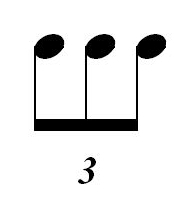
Lastly, we have syncopation, also known as triplets.  Most triplets will be in values of three such as 3, 6, 9, etc.  Usually, you will only see triplets in 3s.  But, any odd number can be used in syncopation.  The basic format looks like this:
Lastly, there are specific symbols in rests that we use for each division of beat.  Rather than go through them all again, here is the tree for their values:
Come back for the next section of music notation which deals with key signatures, time signatures, and repeats.

Friday, October 21, 2011

Music Lesson 2: Tones, Semi-Tones, and the Major Scale

Now that we have a basic understanding of the Chromatic Scale, lets take a look at note relationships and the Major Scale.

Tones and Semi-Tones

As we move our way up the Chromatic Scale and back down we are moving in a specific order between the notes.  Now, every time you move from one note to another you are moving in what is called an Interval.  The term Interval is just a fancy name used to describe the relationship between two notes.  For this lesson, we are going to focus on two types of Intervals.

The most basic of these Intervals is called a Semi-Tone.  On our Chromatic Scale, we are moving one Semi-Tone at a time (or half step as we called it before) as we move up and down the scale.


Notice, as we discussed in the previous lesson, that as you move up or down the Chromatic Scale you are also moving one fret at a time (this applies to guitars, ukuleles, and any other fretted instruments* such as mandolin).


Now lets double the Semi-Tone.  When you add two halves, you get a whole, right?  (I hope you know this already...)  Well, when we do two half-steps, it becomes a whole step or one step. And when we do two Semi-Tones, we get a Tone.

As we move up or down the neck of our instrument(s), this means we are moving two frets each time.  So, let's try to move from C to C up the neck only in Tones.


Do you see what happened there?  In six steps we got to our next C.  Also, we ended up with a bunch of sharps (or flats depending on if you go up or down).  We haven't really discussed keys yet, but a general rule is that the key of C has no flats or sharps in it.  It's all natural!

The Major Scale

So, we need to make our way from C to C (up and then back again) while doing two things: not hitting any sharps or flats, and using each natural note in the scale.  When we do this, we get the following:


Now, let's compare this to the Chromatic Scale we learned in the previous lesson.


Notice how we skip all of the sharps/flats and move in a specific order.  Let's look at this in relation to Tones and Semi-Tones.


This formula of T, T, S, T, T, T, S is what we call the Major Scale Formula.  Moving in this manner is also called Diatonic.  For now, just think of Diatonic as meaning alphabetical.  Using this formula, you can now start on any note and find any scale!!!


Now, let's relate this to our fret boards.  Here is the C Major Scale on the ukulele and the guitar.


And here is the same scale with us jumping to different strings when we can.


One of the great things about fretted instruments is that you can move things around very easily from one note to another just by shifting to another fret.  With our Major Scale, we need only start at another spot and use the same pattern to generate new Major Scales.  In future lessons, I will show some of the many different scale patterns or fingerings that exist.  These will come in handy.  For now, try to find different ways of fingering different Major Scales up and down the neck.

Note:  For ukuleles, major scale patterns can be a little restrictive in regards to the different ways you can finger them.  This is because most ukuleles are tuned in reintrant tuning and your primary strings for the pattern will be limited to three strings (the C, E, and A strings).  If you are using linear tuning (also known as low G tuning), then it will be easier to come up with multiple Root to Root scale patterns since you now have four strings to work with.  I'll try to shed some light on this in the later lesson.

~DB


* Some exceptions of this include mountain dulcimer.  There are others in more exotic music styles that do not follow this rule.  However, in general, this is true for fretted instruments.